Some albums never truly disappear. They simply wait to be rediscovered.
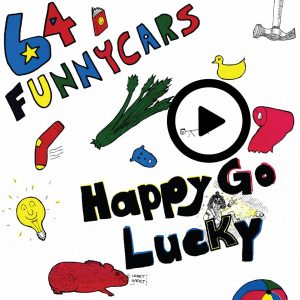
That is the case with Happy Go Lucky, the debut album by 64 Funnycars from Victoria. After decades out of print, the record returns through 604 Records, introducing a new audience to a defining moment in Canada’s late-1980s college rock landscape.
Released during the campus radio era, the album reflects a time when independent music was closely tied to radio stations, small venues, and local communities. These networks played a key role in shaping emerging bands and regional sounds.
Musically, Happy Go Lucky blends power pop, melodic punk, jangle pop, and indie rock. The focus is on energy, melody, and direct songwriting rather than technical complexity or polished production.
64 Funnycars formed in 1987 in Victoria, emerging from the University of Victoria campus radio environment. The members connected through shared listening habits and a common appreciation for bands such as the Young Fresh Fellows, Hoodoo Gurus, and The Replacements. Instead of copying these influences, they developed a shared approach to songwriting built on immediacy, strong melodies, and straightforward structure.
Early performances at Harpo’s quickly shaped their identity. The group performed without fixed setlists and shared vocal duties across members. This created a live dynamic that felt flexible, energetic, and cohesive.
At the time, Victoria’s independent music scene included heavier and more abrasive acts such as Nomeansno and The Dayglo Abortions. Within that context, 64 Funnycars took a different direction. Their sound emphasized melody and rhythm over aggression, resulting in a fast, hook-driven style that remained accessible while still carrying punk-influenced energy. This contrast helped the group stand out within a diverse local scene.
The album was recorded over a single weekend at Seattle’s Egg Studios with producer Conrad Uno, known for his work with The Posies, Mudhoney, and Sonic Youth. The recording approach was intentionally minimal. Vocals were often captured together, most tracks were recorded live, and the group stayed in a van during the sessions. This process preserved the spontaneity and natural energy of the performances.
Happy Go Lucky remains compelling because of its clarity, immediacy, and strong sense of identity. The songs focus on melody, rhythm, and shared vocals, while exploring everyday themes such as relationships, uncertainty, and small personal moments. The tone shifts naturally between playful and reflective, creating a balance that still resonates today.
The early development of 64 Funnycars was closely tied to campus radio and independent music networks. Their first cassette release received airplay on UVic and UBC stations, helping them reach audiences beyond their local scene. They later recorded Happy Go Lucky and Hogwild in Seattle, capturing a direct representation of their live sound. The group toured across Canada, reached No. 5 on national campus radio charts, and was voted Victoria’s Best Band in 1989.
Following lineup changes in the early 1990s, the group continued performing until 1992. After the band’s initial run, members remained active in various music projects across Canada, continuing to contribute to independent music scenes. Occasional reunion performances over the years have maintained the connection between the original members.
The reissue of Happy Go Lucky through 604 Decades restores access to a record shaped by a specific cultural moment. It reflects an era defined by campus radio, DIY recording practices, and tightly connected local music communities. Rather than relying on image or trend, the album endures because of its focus on energy, songwriting, and shared expression.
July 25 – The Fox, Vancouver. For listeners drawn to Buzzcocks, Sloan, Hüsker Dü, and The Posies, Happy Go Luckyremains a significant and rewarding listen. 🔗 more info – 64 Funnycars



 The album was recorded over a single weekend at Seattle’s Egg Studios with producer Conrad Uno, known for his work with The Posies, Mudhoney, and Sonic Youth. The recording approach was intentionally minimal. Vocals were often captured together, most tracks were recorded live, and the group stayed in a van during the sessions. This process preserved the spontaneity and natural energy of the performances.