Kye Alfred Hillig – The All-Night Costume Company: An Indie Rock Album Born From Collapse in Tacoma
There are records that arrive like intention, and others that arrive like necessity.
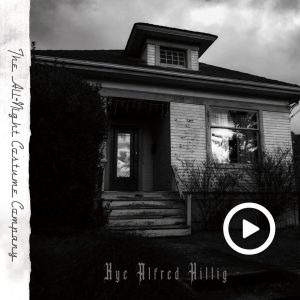
The All-Night Costume Company, the ninth album from Tacoma songwriter Kye Alfred Hillig, belongs entirely to the second category.
It does not feel designed. It feels unavoidable.
The album emerges from a long stretch of silence, withdrawal, and instability that followed Hillig’s decision to step away from music after his 2022 release In All Colors Singing Back. At the time, the exit felt final. Music had begun to feel like something that drained more than it gave back. But what followed was not peace. It was absence. And absence, over time, became heavier than the work itself.
Hillig has spent more than two decades moving through the underground music world of the Pacific Northwest, shaped by the emotional density of Tacoma and the wider atmosphere of Puget Sound. His songwriting has always carried a sense of lived tension, the feeling that music is not separate from survival, but part of it.
When he re-emerged for a rare live performance in late 2024 at Edison Square in Tacoma, it did not feel like a return to form. It felt like a point of contact. Something in the room shifted. Not dramatically, but decisively enough that it could not be ignored.
After that night, the message from his band was simple. A record needed to happen.
Not for career momentum. Not for narrative closure. But because something unfinished was still there.
That band, guitarist David Bilbrey, keyboardist Bill Nordwall, bassist Yoswa, drummer and multi-instrumentalist Jasen Samford, and vocalist Annie J, became the structural core of what followed. They did not simply support the songs. They held them in place long enough for them to exist.
The writing process that followed was not orderly. It came in fragments, shaped by urgency rather than planning. The album began to form as a response to a silence that had stretched too far, turning inward instead of resolving outward.
Recording took place in late 2025 at Ex Ex Studios in Seattle, where producer Johnny Nails approached the sessions with restraint rather than control. The goal was not to refine the material into something polished, but to preserve its instability. What came through is a record that feels deliberately alive, not corrected into stillness.
The sound of the album moves between intimacy and expansion. Hammond organ textures rise and fall like weather systems. Guitars remain careful, never overstated. The rhythm section carries a constant, grounded tension. Everything feels slightly exposed, as if the recordings were captured in motion rather than constructed afterward. At the center of it all is Hillig’s voice, weathered but direct, never distanced from what it is describing.
Lyrically, the album is shaped by emotional confrontation rather than abstraction. It deals with collapse, avoidance, responsibility, and the difficulty of staying present when withdrawal feels easier. Hillig describes the process in simple terms, saying, “I woke up to the only church I know. It’s my band.” In the context of the album, the line is not symbolic. It is literal. It describes what remained when everything else stopped functioning.
That sense of directness runs through the songs themselves. “Ezekiel Bobbing For Apples” reintroduces Hillig with sharp melodic clarity, carrying the feeling of someone re-learning how to speak in public after a long absence. He has described it as “singing up from the bottom of the well,” a phrase that captures both distance and effort without turning it into metaphorical decoration.
“Our Remaining Pig” moves in the opposite direction. It is slower, heavier, built around a stark image from art therapy: a farmer crossing a river toward the last living pig on his land. The song does not resolve that image. It stays inside it. Hillig describes its emotional core with directness: “Sometimes the hard thing is exactly what must be done.”
Across its length, The All-Night Costume Company sits within the language of indie rock and indie folk, but never fully settles into genre identity. There are echoes of emotional scale reminiscent of Arcade Fire or The National, and moments of songwriting clarity that align with artists like Kevin Morby or MJ Lenderman. Still, the record does not position itself within reference points. It remains grounded in place, process, and lived experience.
What gives the album its weight is not transformation, but continuity. It does not tell a story of recovery. It documents the refusal to disappear. It exists in the space where silence stops being neutral and starts becoming pressure, and where returning to music is not a choice of ambition, but of necessity.
In that sense, The All-Night Costume Company is not a reinvention and not a comeback. It is a record made because stopping was no longer sustainable. And in 2026, in a music landscape shaped by speed and constant output, that alone makes it stand apart.